Drinking water from farm wells: nitrate, bacteria and testing
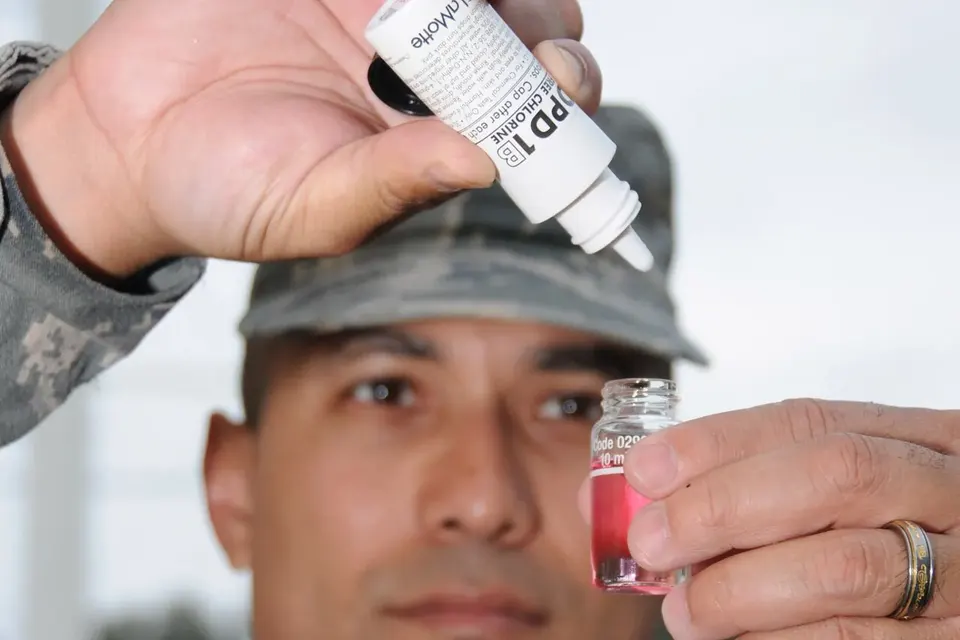
On many Central Valley dairies, the house, the bunkhouse and the milk barn all draw water from the farm's own wells. Unlike a city system, a private domestic well has no utility testing it. The two contaminants that matter most in this setting — nitrate and bacteria — cannot be seen, smelled or tasted, so the only way to know the water is safe is to test it.
Nitrate
Nitrate reaches groundwater from fertilisers, manure, septic systems and naturally from soil. In the Central Valley, the State Water Board has described dairies as an outsized contributor relative to other sources in parts of the valley, and a significant share of domestic wells in affected areas exceed the drinking water standard.
The federal and California maximum contaminant level for nitrate is 10 milligrams per litre measured as nitrogen (equivalent to 45 mg/L measured as nitrate). Laboratories may report either unit, so check which one before reading a result against the standard. Nitrite, a related compound, has a limit of 1 mg/L as nitrogen.
The main health concern is for infants under six months. Their bodies convert nitrate to nitrite, which interferes with the blood's ability to carry oxygen and can cause methaemoglobinaemia, the so-called "blue baby syndrome". Pregnant women are also advised to avoid water above the standard. Water high in nitrate should not be used to prepare infant formula or for drinking and cooking. Boiling does not remove nitrate; it concentrates it as water evaporates. Bathing and showering are not a concern, because nitrate is not absorbed through the skin.
Bacteria
Total coliform bacteria are an indicator: most are harmless, but their presence shows that surface water or soil has found a way into the well. A positive test for E. coli or fecal coliform means contamination by human or animal waste and a risk of illness. On a dairy, the usual routes are a damaged or poorly sealed wellhead, a well casing that does not extend high enough above ground, a well downhill of corrals or ponds, or floodwater over the wellhead.
What and when to test
The US Environmental Protection Agency advises private well owners to test at least once a year for total coliform bacteria, nitrate, total dissolved solids and pH, and to test again after a flood, after any work on the well or plumbing, if the taste, colour or smell of the water changes, or when a household member is pregnant or there is a newborn. Use a laboratory accredited by the State Water Board's Environmental Laboratory Accreditation Program, and follow its instructions for sterile bottles and delivery times; bacteria samples must reach the lab quickly.
How the dairy order samples wells
Under the Monitoring and Reporting Program of the Central Valley dairy order (R5-2013-0122), each domestic and agricultural supply well on a dairy is sampled:
- annually, with field measurements of electrical conductivity and ammonium nitrogen and a laboratory analysis of nitrate-nitrogen;
- every five years, for general minerals (calcium, magnesium, sodium, bicarbonate, carbonate, sulfate, chloride and total dissolved solids), which can be spread over the period by sampling a fifth of the wells each year.
The order also describes how to take the sample. For a domestic well, water is collected from the tap nearest the pressure tank — before it if possible — after running for 10 to 20 minutes; if that is not possible, the well is purged of at least twice the tank's volume. For an agricultural well, the pump runs for at least 30 minutes, or until three well volumes have been purged. These steps make sure the sample comes from the aquifer rather than from water sitting in pipes.
That monitoring is designed to characterise groundwater under the dairy, not to certify that a particular tap is safe. A household that drinks from the well should look at the nitrate result each year with that question in mind — and should add a bacteria test, which the dairy order does not require.
What changes after September 2026
In Order WQ 2026-0028, adopted on 15 September 2026, the State Water Board directed the Central Valley Water Board to issue, within two years, investigative orders requiring monitoring of drinking water wells on and off dairies and, where appropriate, the provision of replacement drinking water. Separately, the Central Valley's salt and nitrate control programme, developed through CV-SALTS, requires nitrate dischargers in priority groundwater basins to ensure safe drinking water for affected residents. Residents unsure whether either applies to them can ask the Central Valley Water Board.
If a result is high
- Stop using the water for drinking, cooking and infant formula; use bottled or another safe supply.
- Retest to confirm, and check the wellhead, casing and seal for damage.
- For bacteria, a qualified well contractor can disinfect the well after the cause is fixed; retest afterwards.
- For nitrate, treatment options for drinking water include point-of-use reverse osmosis and ion exchange units certified for nitrate reduction, which need regular maintenance. A deeper or relocated well is sometimes an option.
- Ask the county environmental health department about local assistance programmes.
For health questions, consult a doctor; for well construction and treatment, a licensed well contractor or the county environmental health department.
Sources
- US Environmental Protection Agency, Private drinking water wells and National Primary Drinking Water Regulations (nitrate and nitrite limits).
- Central Valley Regional Water Quality Control Board, Order R5-2013-0122, Monitoring and Reporting Program, Table 4 (groundwater monitoring).
- State Water Resources Control Board, Order WQ 2026-0028, 15 September 2026, sections I.H, III.C and III.J.
- Central Valley Water Board, CV-SALTS and the salt and nitrate control programs.
 Water & nutrients
The dairy General Order, 2007–2026
The 2007 order, the 2013 reissue and the State Water Board's 2026 nitrogen framework, in plain terms.
 Safety & emergencies
Dairy emergency planning
A contact sheet, a map with valves and ponds, and a plan for the first hour of a flood, spill or outage.